Wednesday, June 6, 2012

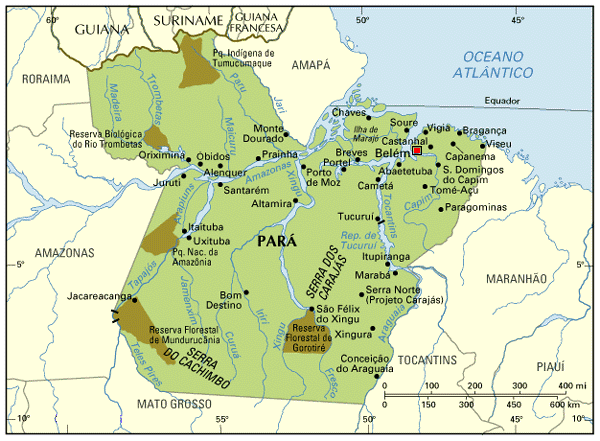
It's odd to be wrapping everything up here in Brazil already and to be getting ready for my trip home. The end of my time in Altamira was lovely; I enjoyed spending time with some Brazilians who showed me around the city and took me to the best ice cream parlor and hanging out with my host family. A friend of mine was doing research in Medicilandia, a town about 3 hours away by bus, on organic cacau cooperatives, so Amy and I decided to make the trek to the cacau farm she was working on for an enjoyable weekend away from the city. She was living with the sweetest family, all of whom we were able to meet at the great grandfather's birthday party on Sunday.
Making homemade bread for breakfast
I spent most of my time there hiking around the 93 hectare farm taste testing the best chocolate I have ever had, and eating amazing food. We had the best time riding around in the back of the pick up truck while the sun was setting. I am still not totally convinced that this is real life.
My final paper is finish and ready, and all I have left to do is printing and my presentation. Then we will go to a hotel for 4 days for our evaluation period, and after I will return to the states.
As much as I am so excited to see my family and friends, I am hardly ready to leave this place. This has been the most incredible adventure and I don't want it to end.

Xingu Vivo!

Monday, May 21, 2012

"What fish?" was the typical response I have been getting from the Pescadores I have been interviewing on the Volta Grande...not quite the response I was hoping to get but very telling about the current biological state of the Xingu since preliminary construction of the Belo Monte began about a year ago.
But let's rewind...
On Tuesday morning, Amy and I began our remarkably long bus journey to Altamira. We got to the bus terminal at 8 am, convinced that we were in for a 12-15 hour bus ride, only to be informed that we would actually be spending about 19 hours of our lives on a not all too comfortable bus. After spending the first 7 hours both reading the first Harry Potter book, we attempted to waste time staring out the window and taking turns sleeping.
Around 4 am, we finally made it to our new homestay in Altamira and passed out for 4 hours before running off to our meeting with Xingu Vivo. There, we were informed that we would be leaving the next day for a boat trip to somewhere on the Xingu to meet with some people that might help us with our research, so bearing this in mind, we stocked up on rice and beans and prepared for our journey. We finally had a chance to get to know our host family in Altamira, who own a joint sticker making-dress making shop on the main street here called Lua de Mel. Mano and Alessandra are quite possibly the most friendly people and have been really helping me with my Portuguese. They cook breakfast, lunch and dinner for us every day and have provided basically a boarding house for the Americans who are doing research nearby (namely, Amy, Stephanie, and me).
The next morning, Amy and I boarded a small dingy with a man who was introduced to us as Jose Paulo, hoping that we would be able to get some sort of research completed. This 3 day trip went above and beyond my expectations; we visited 3 communities, one that has already been vacated due to water pollution from initial construction, one that only has 3 families left, and one that has not yet been vacated, but whose families are planning to leave once the fish population drops so much that they can no longer sustain themselves.
The ghost town of São Pedro


I spent much of my time on the Xingu speaking with various fishermen, visiting the headquarters of communities, fishing, tanning, swimming, and altogether enjoying life. It's awful to think that in 2-3 years, no one will be able to see this place...construction should be finished by 2015 and the entire area will be flooded. In an area with one of the highest populations and biodiversity of fish in the world, it is awful that the population has already dropped so low and that water quality is so bad here that about 100 families have already had to leave.
I am hoping to go to Medicilândia this weekend to see how the lives of the fishermen have changed since leaving their homes on the Xingu and hopefully I will be able to bring back some organic chocolate from the cacao cooperatives there.
Here are some photos of the most beautiful place in the world
Amy and I checking out the construction of the Belo Monte Dam


Catchin some fish
Helping out the family by picking oranges
My Xinguese family
Rio Xingu at sunset

Monday, May 14, 2012

Living for 5 days in and MST community definitely proved to be eye opening, but not quite in the way that I expected.
Land rights in Brazil are relatively complicated and stem from the last agrarian reform during the military government's push to develop the Amazon. Only 5% of the land here is actually owned by someone; the rest is government property that is leased out to various farmers and traditional populations. While the traditional populations have rights to the land indefinitely, farmers technically only own the land as long as they keep it productive. If the land is not productive for more than 6 months, the government technically can take over the property and redistribute it.
The idea behind the MST movement is for landless rural workers to reclaim the land that they believe to be owed to them by the government due to the PIN program. In theory, they occupy land of large farmers who claim much more land than they actually deserve/use and as a collective body "conquer" the land. In practice, many of those vying for land are not always rural workers. Every MST member I met was actually from the city and they had no interest in cultivating the land to sustain their families at all. While I am aware that all MST communities are different, the one I lived in was essentially developing very quickly but had no way to control the development and therefore was becoming a slum. I am not all too sure how I feel about the concept of MST both in theory or in practice, and I do not feel qualified to actually make any judgements, but what I will say is that this experience taught me that I can never come to a definitely conclusion about anything before experiencing what it is I feel the need to make a decision about.
My life with the MST mostly consisted of watching Barbie Disney Princess movies with my host sisters and helping to take care of the 1 year old baby. I had so much fun practicing Portuguese with them and teaching them ballet and my host family was absolutely lovely. It's funny how I find myself feeling so much more comfortable in my rural homestays than I do in Belem.
My research project is approved and I am leaving in the morning for Altamira. I will be living on a boat for another week with members of Xingu Vivo who will be taking me to various communities along the Xingu so that I can conduct interviews about the current fishing habits of these traditional populations. I cannot wait to begin my research and I hope I am able to accurately represent these people despite my sub par Portuguese...

Wednesday, May 9, 2012

A roadtrip, of sorts
I got in the van with absolutely no idea of what to expect during my trip to the South of Para, and I am relatively certain that it changed my perspective on development and social organization in Brazil entirely. The more I think about it, the more I realize that it might take years for this trip to sink in completely and for me to actually comprehend what I have seen here.
We began our journey by driving to the Tucurui Dam, one of the largest hydroelectric dams in the world. It is really is overwhelming to see the ways in which humans can alter and control something has huge as a tributary here in the Amazon...the Tucurui Dam is able to produce 8370 MW of energy and even that amount pales in comparison to the 11232 MW that the Belo Monte is projected to produce post construction. The major driving force behind the construction of large damming projects in Brazil is the aluminum production here. 1.5% of total energy consumed in Brazil is done so my Albras, the company that produces aluminum from bauxite. Belo Monte is basically being created for Albras, but when I visited Albras I realized that the corporation actually has the only water treatment facility in the area so that it can produce clean water for the surrounding region and it has a waste treatment facility which the government does not provide. While the energy consumption is outrageous and while there are myriad issues with these damming projects that actually have relatively viable solutions, we do need aluminum production and Albras does a great job of being energy efficient.
Post Tucurui, we visited a Colonos ranch (colonos are those who came to occupy land after PIN to receive free land for making it productive) and were able to assess the economic value of their various agricultural and ranching practices. Land rights in Brazil are really interesting because only 5% is actually owned privately. The rest is all governmental land, of which the government gives out legal rights to those who agree to make it productive. If the land is not productive for 6 months, then technically the government can take the land back and redistribute it, unless the land is marked as legal reserve and then it can remain forested. This sets up a really interesting scenario because currently Brazil is being pressured by the international community to reforest land. However, they wanted to develop the Amazon to protect it from being taken over during World War II so now rural workers who were told to deforest the area are being told to reforest it and aren't getting compensated by the government. The social problems that stem from this are astronomical, which led to the MST movement in Brazil. Since the issues with MST are so intense, I think I'll leave my description of them and my time living with them for another day, especially since this has already gotten my head spinning again...

Some friends and I visiting a Mexican restaurant in Brazil, of course

Sunday, April 22, 2012

Well, I am finally going to try and finish up explaining my boat trip about 2 weeks after it ended and about 1 day before I leave again for the South of Para and will not have internet for another 11 days. The end of my trip culminated in a rural homestay with a ribeirinhos family near Juruti. Living with this family was one of the most amazing experiences of my life...I spent the days searching for fruits and brazil nuts in the forest and learning how to fish with nets in the river. I had about 6 or 7 children crawling all over me at all times and I have numerous pages in my notebook of doodles that we spent hours doing. In the late afternoons, we would spend hours playing soccer and the moms would even join in. These are the kids in my homestay family: Sauri, Alberth, Tomi Ta, and Tomi Carlon.
 On Sunday, the four communities that live near each other have a soccer tournament, so we hosted another community at our soccer field for a pretty intense game. Right before the game, I went to look for fruit in the forest and ended up by the farinha huts where the boys outside decided to throw brazil nuts at each other. I was lucky enough to be standing in the way of a particularly well thrown one that hit me just above the temple and had a great time sporting a black eye and welt on my head for about 2 weeks after. I was taken by the children down to my host mother who took care of me while the entirety of the two communities watched resulting in probably the most embarrassing experience of my life. However, the soccer game was amazing and afterwards I hung out with some locals and practiced conversational Portuguese. My host mother was very involved in the community so I was able to go to meetings and church and really understand the inner workings of it. Everyone in the community feels like one family and they do all they can to look out for one another. Education is on the rise, though they do not have access to proper materials until they reach high school age. It seems that only 5 or 6 boys are able to move to Juruti for school and they return every weekend with goods for the town. Upon leaving, my host mother began to cry and I realized why Brazilians have the word saudade....leaving someone you're relatively sure you're never going to see again that have truly touched your life.

Beyond this, life in the city has been interesting but not very noteworthy. I was able to visit Boa Vista, a community just north of Belem where we were all bathed in herbs to attract positive energy and apparently boyfriends, something that Brazilians hold in the highest esteem. I also visited the bird conservatory here, which is absolutely beautiful and a lovely paradise in the middle of the city.

I am leaving tomorrow for the South of Para and should return around May 3rd, so hopefully by then I will have plenty of stories to tell

Saturday, April 14, 2012

After spending two days on the boat traveling down the river, we finally made it Trombetas, another port city in which MRN (Mineração Rio do Norte) uses strip mining methods to mine bauxite which is in turn used to create aluminum. Throughout my time here, I have been able to see the entire process from the mining of the bauxite, the distribution of the alumina, and finally to the creation of the aluminum. Brazil has about 6 billion tons of bauxite and exports the majority of the aluminum they produce, though the Brazilian consumption is expanding with their rapid economic development. After seeing the mining process, we met with the Quilombolas (escaped African slaves who created communities along the river). They basically partake in low impact activities on the land, but they are living in an area that has recently been deemed a conservation area, so they are no longer allowed to keep animals on the land and are restricted in the amount of fishing and hunting they can do. In addition, MRN has the rights to the minerals in their land, as people are able to own surface area but anything below the surface is federally owned and then leased out to large corporations. It has been interesting to see the development of this contention between federal conservation practices, corporations, and local communities that have been living on the land for quite some time. All of these interests have very opposing needs and trying to find a balance has proven to be difficult throughout the entire Amazon region, mostly, in my opinion, because the government does not do much in terms of understanding social conflicts, resource needs, and ecological concerns.
The head of the Quilombolas community took all of us around and showed us how to find Brazil nuts and open them with machetes, which they can sell for a reasonable profit in nearby towns.

In addition, sunrises over the Amazon are the most beautiful in the world

Friday, April 13, 2012

My first day in the boat, I was able to swim at the meeting of the waters (where the black water system and white water system meet). The white water is comprised of tons of sediments due to the run off of the Andes and the black water flows from the Rio Negro, and you can see a definite line between the two because of the differing flow speeds, temperatures, and densities. The black water was much warmer than the white, which is why you can see me sticking to the black water section. It also has a much higher biodiversity, so approximately 1 minute after this picture was taken i felt a large water creature brush past my leg and I decided it was about time to get out of the water.


Thursday, April 12, 2012

After spending so much time away from the cyber world, I'm not sure that I can do the past month of my life justice. I will, however, attempt to go through my trip chronologically in hopes that I can remember as many anecdotes as possible to encapsulate the vibe of my time boating down the Amazon. I plan to update in stages so that this blog post doesn't turn into a novel....
I began my journey in Manaus, a major port city that rose to popularity during the rubber boom in the late 1800s. After going through a long period of economic depression, Manaus is now a touristy city that seems to me to be more used to seeing white people walking around than those in Belém. We found an amazing restaurant there that served vegetarian dishes (absolutely unheard of in Brazil) and became fast friends with our waiter there
He told us all about his life and thanked us for coming there to eat and it was so refreshing to finally be able to somewhat understand Portuguese.
While in Manaus, we traveled up to the north and visited a conservation forest there where there are many environmental studies going on. You're only allowed to visit it as a researcher or student, so the area is remarkably pristine and we were able to see monkeys and other wildlife wandering around. At 4:30 in the morning, 6 other students and I decided to hike 2 miles in the forest in the dark in order to reach a 70 meter high metal ecological tower that researchers use to measure UV rays, microclimate, temperature, etc. We climbed the ladders and watched the sun rise over the forest while hearing a group of howler monkeys nearby and watching all of the Amazonian birds flying by. After the sun rose, a rain storm swept towards us over the tree line and we decided it was probably time to hike back to the ecology lodge.


I will post more pictures of the sunrise when I am able to upload them, and I will continue to post more about my month on the river as I have time. I've never been in a place to beautiful in my entire life and this place has completely changed so many of my views on politics, environmental studies, and understanding interests groups.
 

Sunday, March 18, 2012

My excursion to São Francisco do Pará and Igarapé-Açu proved to be both remarkably interesting and beautiful. We spent the first two days studying forest processes, slash and burn agricultural practices, and forest succession. Our last day, we met several farmers and organizations that use alternative farming practices to enhance crop production by using crop and drop agricultural practices rather than slash and burn.
These farms were amazing to visit; they maintained the soil health by increasing the diversity of the species rather than burning an area of land and creating monocropped fields. This is a relatively new way of thinking for many of these farmers, but in the long run you are using the natural functions of plants to reduce pests, increase nutrients in the soil, and increase crop yields. This means that no fertilizers and pesticides are necessary; instead, they allow plants to do their job. The system is by no means perfect yet. One of the farmers we met with does not seem to have a proper irrigation system in place, and I can only assume the cost of energy to bring water to his fields must be rather high. However, it's amazing to see such a beneficial movement towards sustainable and economically beneficial farming practices here in Pará.

 One of the several diversified farms we were able to visit


While visiting one of the farms, we were able to see people making farinha, a hard flour concoction that Brazilians eat with everything, especially rice


Jeff, Molly, and Amy in the back of Gustavo's truck on our way to learn about the impacts of fire on tree regrowth


Delphi made a new friend on the farm! This is Bambi, the friendliest horse I have ever met.

Tuesday, March 13, 2012

São Francisco do Pará and Other Musings


Tomorrow morning, I will be leaving for São Francisco do Pará, a beautiful village in the South of Pará. Here, I believe I will be learning about tropical forest succession and local conservation issues, though I am not quite sure of specifics. We will be there for three days, after which I return to Belem for the weekend before going on my first long excursion! On April 19th, I will fly to Manaus with everyone on my program and we will live on a boat together for 17 days as we travel from Manaus to Santarem. I am remarkably excited to see a large portion of the Amazon River and learn as much as I can about environmental issues that are affecting the river and those who live on it.
I am still trying to decide what I want to study in my last month here for my Independent Study Project (ISP), though I am leaning towards studying the effects of the Belo Monte Dam on indigenous fishing cultures, migratory fish patterns, and perhaps water quality. However, I am also very interested in studying agrarian land use change due to biofuel production here in Brazil, as most of their energy is derived from ethanol. It would be interesting to better understand the pros and cons of biofuel production, the ways in which they create ethanol from sugar cane, the impacts on food production, indigenous rights and biofuel production, and the like. I'm sure as I visit more places and learn about more environmental issues, my list will grow, so I am trying to stay focused so that I can create a useful and practical final project.

Tchau for a few days!

Saturday, March 10, 2012

I've always known that no two people experience time in the same way, but I never quite grasped how differently Brazilians and Americans experience the world until I came to Belem. Brazilians live their lives on p-time, or polychromatic time, meaning that they are used to doing multiple tasks at once and do not compartmentalize their activities into time slots like we do in the United States (monochromatic time). Here, I hardly ever look at a clock to know the time because time here is not the same. Brazilians are often late to meetings or events and it's not considered rude or out of character. Instead, time is flexible and changes in schedule is simply a natural part of the day. As an American, I find this way of life freeing. Days seem much longer and much fuller here, whereas in the United States it's easy to get so caught up in a schedule that one forgets to live in the moment. The focus shifts from work and routine to life and interactions, something that I think I personally am benefiting from the most here. This is not to say that Brazilians are not hard working; on the contrary, many of the Brazilians I've met here work very hard to earn a living and create a comfortable life for them and their families. However, they are also more able to relax and enjoy each moment rather than be constantly concerned for what the future has to bring.

Friday, March 9, 2012

Well I have been living in Brazil now for just over a week, and what a week it has been. For the most part, I've been living in a hotel with 20 other amazing men and women who, like me, are interested in resource management and ready for an adventure. Everyone on my program is incredible, from the other students to our professors.
Our first excursion in Para included a trip to the mangrove forests. There, we climbed on the branches of the mangrove trees and learned how the locals catch crabs and the contention between conservation groups that want to conserve the area and locals who have been catching crabs there for centuries. It's interesting to really consider what you are trying to conserve, whether it be a lifestyle, species, or resource. We then hiked two miles to a fisherman's home and he and his family cooked us fish that he had caught that morning. It was incredible to be able to talk with him about his livelihood and the sustainable ways in which he lives. Interestingly enough, many of the fishermen that live on the beach technically aren't supposed to build houses there, but when they hear that the government is going to conduct a raid, they simply pack up for a few days and come home after the raid is over.

I now am living with my host family in Belem, and I could not have gotten luckier in this respect. My host father, Ruy, speaks english as does his daught, Thais. The younger daughter, Ellen, is 10 and she is learning English as well and the mother, Raquel, knows no english at all. I am doing my best to be able to speak in Portuguese, but it is so different from what I am used to and I haven't been here for very long at all. The culture is so beautiful; the family is very close and we always keep our doors open. For the most part, I am in a very safe and beautiful city and I could not be happier with the fact that I am able to live here in Brazil.

Tenho que ir agora...Tchau!

Tuesday, February 14, 2012

My friend recently shared this picture on facebook with a description attached at reads:
I hope that this image travels the world . . .

"While newspapers and television talk about the lives of celebrities, the chief of the Kayapo tribe received the worst news of his life: Dilma, "The new president of Brazil, has given approval to build a huge hydroelectric plant (the third largest in the world). It is the death sentence for all the people near the river because the dam will flood 400,000 hectares of forest. More than 40,000 Indigenous Indians will have to find another place to live. The natural habitat destruction, deforestation and the disappearance of many species is a fact."
What moves me in my very bowels , making me ashamed of being part of Western culture, is the reaction of the chief of the Kayapo community when he learned of the decision—his gesture of dignity and helplessness before the advance of capitalist progress, modern predatory civilization that does not respect the differences . . .

But we know that a picture is worth a thousand words, showing the reality of the true price of our bourgeois "quality of life".

Sign the AVAAZ Petition to stop the dam here: http://www.avaaz.org/en/amazon_under_threat/"


This picture, along with the description, made me re-examine why I am going to Brazil and conducting the research that I am. The plan is to spend my research period studying the effects of the Belo Monte Dam on indigenous fishing cultures and habits, but what I am really trying to do is much bigger than that. I am trying to create a new way to assess the impact of something rather than just quantifying variables and turning it into an economic venture. It is typical to see our free market as the be all end all economic system, but the way in which our globalized economy has developed is not perfect and is definitely not the only solution. I am searching for a new way to view the world and perhaps find a break from the status quo by learning sustainable techniques from those who know them best. 

Wednesday, February 1, 2012

After a long morning in the city, I am finally 13 days away from having my visa and passport ready to go! Thank goodness February is a short month...the anticipation is killing me. On a lighter note, I had a chance to visit my friend's grandfather's apartment on the Upper West side. It has an incredible view of Central Park and has a pre-war building style that I adore. If I could, I would live there forever.

Friday, January 27, 2012

In 34 days, I shall be living in the state of Para in the amazing country of Brazil. I'll be sure to post pictures and anecdotes to this blog, following my adventure around the Amazon River basin from Belem to Altamira. Enjoy!